The King of Christmas Instruments
From carols to chorales, cantatas and hymns – If there is one musical instrument that dominates the Christmas holidays, it would undoubtedly be the one known as the “king of instruments”, the Organ. In this video, Chuck Nelsen from Cunningham's Classic Organ Group gives an in-depth tutorial to pianist Hugh Sung on how the organ works and how this incredible collection of pipes, of keys, stops, buttons and pedals that gives a single player the power to sound like an entire orchestra! For more details, visit https://www.cunninghampiano.com/the-king-of-christmas-instruments/

During this year’s NAMM show, Tim Oliver, one of the co-owners of Cunningham Piano, received a phone call from his partner, Rich Galassini, with a very surprising announcement: we just won Yamaha’s Dealer of the Year for the entire United States market! Pretty amazing! To better understand how a company like Yamaha decides on these types of awards, and what this ultimately means for our customers, I sat down with Tim to get his thoughts and feedback.

Many folks think that playing the piano is like using a typewriter: press a key, you get a note. But on a typewriter, there are two main limitations: 1. You can't change what each "note" looks like, and 2. You can't repeat that "note" very quickly. What makes the piano action truly remarkable is its ability to provide a nearly infinite range of volume and texture for each note, as well as its ability to enable incredibly fast repetitions, all with a minimum of physical effort. Despite less than half an inch of motion from the top of the key to the bottom of its stroke, the piano action can provide an incredible amount of power from the finger to the hammer that strikes the piano string. I like to call this, "bio-mechanical amplification"! In this video, we explore the inner workings of how the piano action works, and how that translates to provide the piano player with true 3D control of the piano sound.


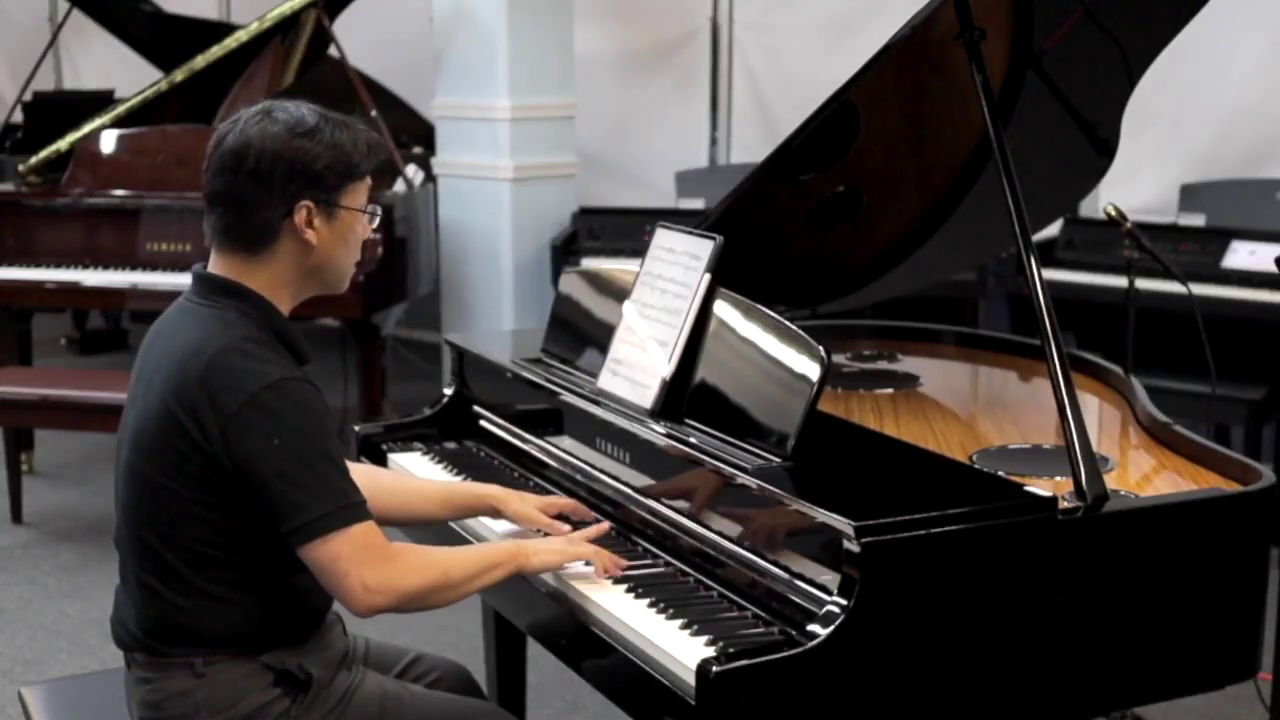


For decades, Yamaha’s Conservatory Series of grand pianos were legendary. They dominated music programs, concert halls, and even recording studios all around the world. As a Testament to Yamaha’s never ending quest for perfection and improvement, Yamaha developed the CX line of premium pianos. Now with that introduction of the CX series, Yamaha had an opportunity to revisit the Conservatory Series and look for ways to offer the DNA, as it were, of their Conservatory Series but in a form factor that was both improved and also more economically feasible for the home, for private studios and even for conservatories around the world. And with that, the Conservatory Series was reborn in the GC series.
Now we’ve got a really interesting opportunity to compare between two pianos of the same family, but different sizes. The GC1 is a 5’3″ grand piano, and the GC2 is 5’8″ from the keyboard to the tail. So let’s have a little bit of fun and let’s compare to see what five inches of size difference can do between these two pianos.